
A unique software solution for cosmetic and pharmaceutical research, delivering advanced analysis of skin hydration and surface roughness. Intuitive visualisation and quantitative tools support accurate comparison of pre‑ and post‑treatment image data for objective assessment of skin health and treatment efficacy.
Feature
Description
Image
Uses
Industries
Image Stitching
Large‑area skin images are created by stitching together a linear sequence of individual images. This process can be repeated for any image set, joining edges—top, bottom, left, or right—to form a continuous combined image.
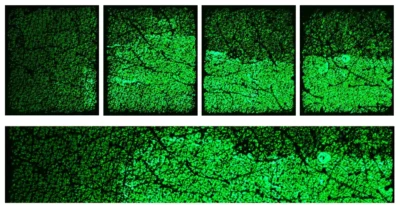
The original Epsilon skin images (top), and the stitched Epsilon skin image (bottom).
The top sequence shows the original discrete Epsilon skin images. Beneath that are the same images combined across a large area of skin.
Skin Hydration
Skin Analysis
Skin Damage
Template Matching
Rapid matching of two or more images of the same skin area.
This enables more accurate and productive analysis of skin image dynamics over time.
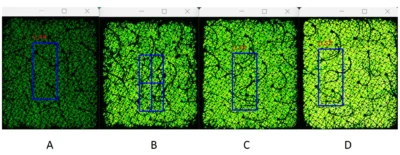
A Region of Interest is selected in image B and the same region is identified in images A, C and D. Image A is pre-treatment and B, C and D are post-treatment
Skin Wound Healing
Skin Disease Treatment
Trans-dermal drug delivery
Skin Hydration
3D plotting
Display the Epsilon image in 3D format.
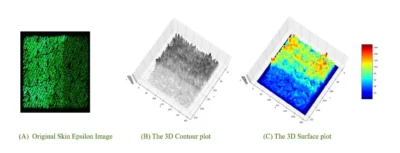
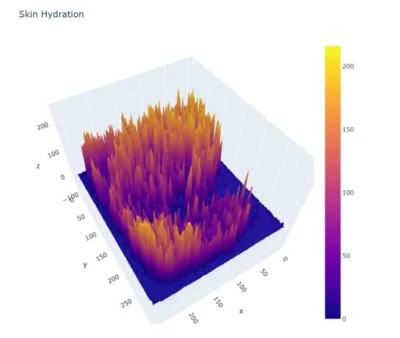
Enhanced visualisation of skin surface hydration
Skin Hydration
Image Segmentation – Clustering
Powerful way to allow users to separate skin from the background or highlight different tissue areas.
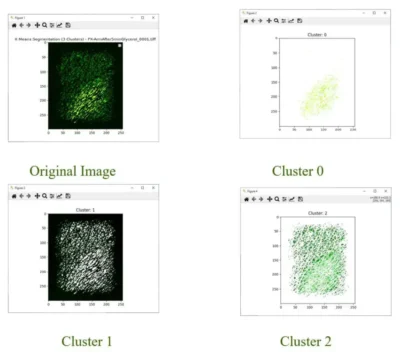
Could measure residues on the skin
GLCM (Gray-Level Co-occurrence Matrices)
Effective way to extract and analyse skin texture information.
The values could correlate with age.
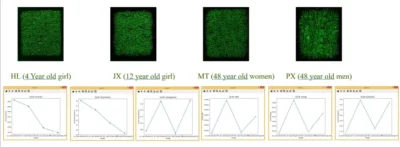
Calculated GLCM-generated feature values
Effects of medical and cosmetic treatments
Skin Roughness
Calculate the skin roughness.
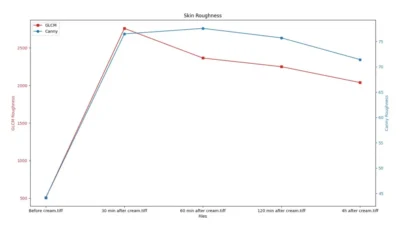
Skin roughness calculated using GLCM features and Canny metrics
Effects of cosmetics
To get in touch with us, please fill in the form below.
Looking forward to hearing from you
Our team of experts is ready to assist with your skin measurement requirements.